Render · Opus 5.5 · medium effort · HIPAA organization · trial 1
Real-Time Collaborative App on Render
Success
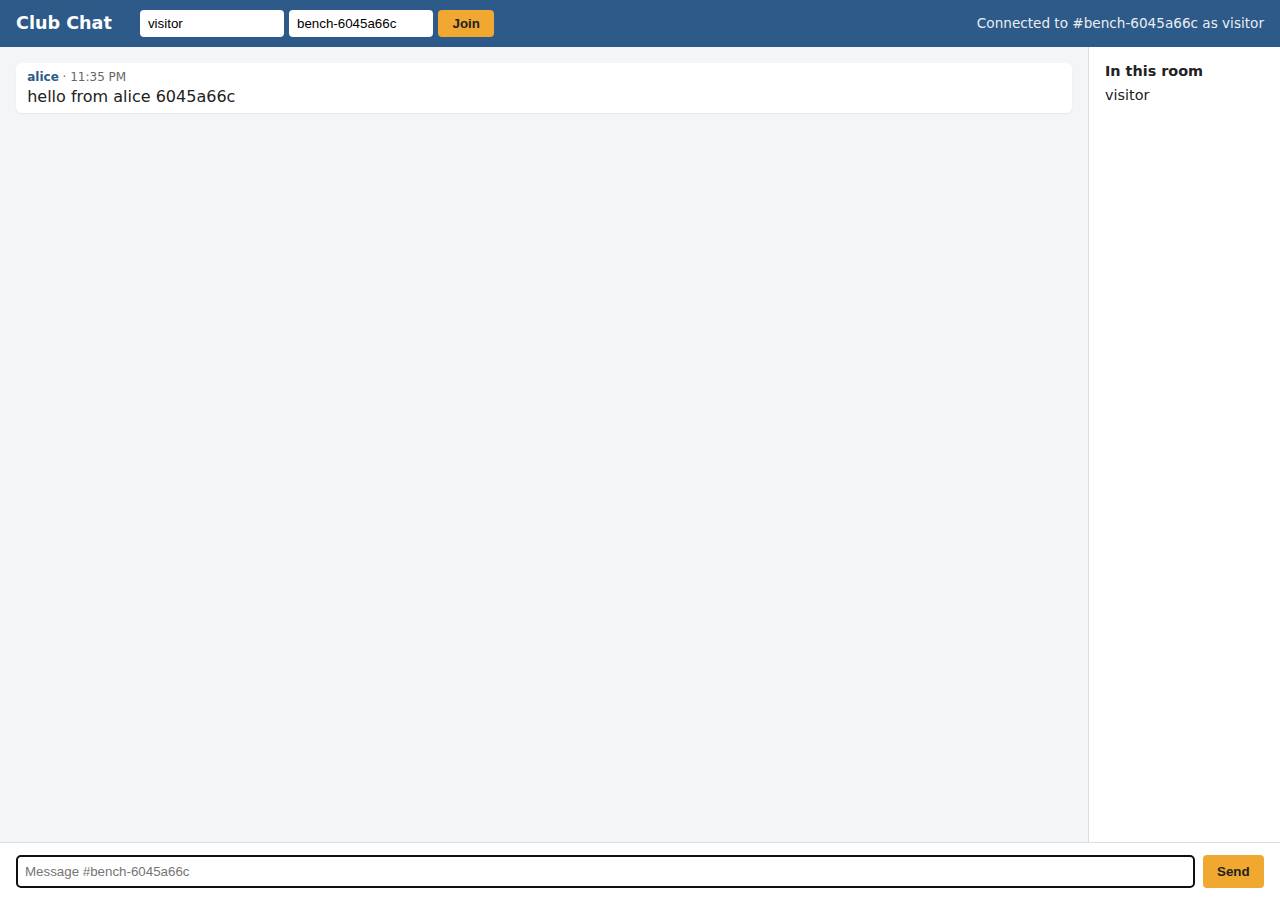
Deployed to https://adb-p9gs9-realtime-web.onrender.com. Every deployment is deleted after it's verified and reviewed.
Screenshots
Technologies
- Runtime
- Node.js 20+
- Frameworks
- Node.js http module (built in)
- Data
- PostgreSQL (Render Postgres, free)
- Libraries
- wsnode-postgres
- Packaging
- Render Blueprint (render.yaml)
- Hosting
- Render web service (free, built from render-examples/express-hello-world)
Named from the app's dependencies, Dockerfile and config files, and the cloud resources it created.
Checks
Black-box checks against the live URL. A cell succeeds when every required check passes. The app's spec
| Result | Check | Details |
|---|---|---|
| passed | GET / answers 2xx within 1 min ready |
|
| passed | The app is served over HTTPS with a valid certificate https |
|
| passed | The app is public: no redirect to another host such as a login page public_access |
|
| passed | GET / serves the chat UI as HTML ui |
|
| passed | deployment.json declares a supported transport (websocket or sse) transport optional |
|
| passed | Clients connect over websocket connect |
|
| passed | A message reaches another client in the same room within 5 s delivery |
|
| passed | The sender receives its own message too echo optional |
|
| passed | Messages never reach clients in other rooms room_isolation |
|
| passed | Five users posting at the same time all see every message within 10 s fanout |
|
| passed | GET /api/rooms/<room>/messages returns recent messages history |
|
| passed | Messages over 1000 characters are rejected validation optional |
|
| passed | The chat UI loads in a browser without errors browser_ui optional |
Human steps
- Sign up for an account and verify the email address · 3 min
prerequisite: account setup - Create an API token and hand it to the agent · 2 min
prerequisite: account setup
Security & compliance review
An independent Claude Code session reviewed the source, the agent's sessions and the live deployment against a fixed rubric (claude-opus-5-5, high effort).
The chat app itself is well built: input is validated, SQL is parameterized, the UI renders safely, nothing sensitive is exposed, and HTTPS is enforced. No secrets leaked. The biggest weakness is provenance: Render builds from a third-party example repo, and the real code arrives as an opaque tarball in a secret file. The free Postgres, which is likely reachable from the internet, expires on 2026-11-12, after which the app will fail to start. Security headers and rate limiting are also missing.
| Criterion | Weight | Score | Why |
|---|---|---|---|
| Secrets handling | 25 | 9/10 | The Render API key and database credentials never appear in the transcripts, source, or the uploaded bundle. DATABASE_URL is a Render service environment variable, and the bundle (built with git archive from an explicit file list) leaves out .env. Minor points: the connection string was set as a literal env var rather than a fromDatabase link, and the external connection string sits in a local .env file. |
| Deployment provenance | 20 | 4/10 | The live service's recorded source is a third-party public repo (render-examples/express-hello-world, unpinned branch main). The real code arrives as an opaque base64 tarball in a Render secret file and is unpacked by a custom build command. What runs can't be traced to any owner-controlled repo or commit. Dependencies are locked with package-lock.json and npm ci, but the Node version is pinned only to the major version. |
| Terms compliance | 15 | 6/10 | Render's free tier is fine for a personal hobby-club app. However, the free Postgres the app depends on expires on 2026-11-12. After that, store.init() will fail at startup and the service will stop working. Spin-down after 15 minutes idle also drops live WebSocket sessions. Both limits were disclosed but not addressed. |
| Least privilege | 15 | 6/10 | The service runs on Render's managed native runtime and the app reads only what it needs. The Postgres database was created through the API without an ipAllowList. Render's default is to accept external connections from any IP (password-protected), even though the app only needs the internal URL. |
| Transport security | 10 | 7/10 | HTTPS works with a valid Google Trust Services certificate, and HTTP returns 301 to HTTPS. The app sets no HSTS, X-Content-Type-Options, frame protection, or CSP, even though it writes its own response headers and could have. |
| Attack surface | 10 | 9/10 | Requests for .env, .git/config, source files, the secret bundle and other paths return the app's JSON 404. Errors are generic, with no stack traces. Only /healthz is extra, and it returns {"ok":true}. |
| Application security | 5 | 6/10 | Input validation is solid: text, user and room lengths are checked, the body is capped at 16 KB, WebSocket payloads at 64 KB, SQL is parameterized, and the UI renders with textContent, so there is no XSS. However, the public endpoints have no rate limiting or connection caps. The per-room cache never evicts, and the WebSocket upgrade doesn't check the Origin header. |
Findings
-
high deployment Production built from a third-party example repo with code injected through a secret file
Evidence: process/deploy.md service creation: "repo":"https://github.com/render-examples/express-hello-world","branch":"main" with buildCommand 'base64 -d /etc/secrets/app.b64 > /tmp/app.tgz; find . -mindepth 1 -maxdepth 1 ! -name app.b64 -exec rm -rf {} +; tar xzf /tmp/app.tgz; npm ci --omit=dev'; process/resources.json source = render-examples/express-hello-world
Fix: Push the app to an owner-controlled Git repo, or deploy a digest-pinned image from an owner-controlled registry, and have Render build from that pinned commit. Don't route code through secret files under someone else's repo.
-
medium deployment Free Postgres expires in 30 days and the app fails to start without it
Evidence: process/resources.json expires_at 2026-11-12T23:32:51Z; app/store.js lines 13-32: init() runs CREATE TABLE against DATABASE_URL and server.js main() exits on error
Fix: Use a paid Postgres plan (Basic) or a persistent alternative. At minimum, fall back to memory or degrade gracefully when the database is gone.
-
medium deployment Postgres likely reachable from the internet
Evidence: process/deploy.md: POST /v1/postgres body has no ipAllowList. Render's default allows external connections from 0.0.0.0/0. The app uses only internalConnectionString.
Fix: Set the database ipAllowList to an empty list (internal-only), or restrict it to the specific admin IPs needed.
-
low platform Free web service spins down when idle
Evidence: process/deployment.json notes: 'sleeps after about 15 minutes idle ... open WebSockets are dropped'
Fix: Use the Starter plan if the club needs the chat to be always available.
-
low app No security headers
Evidence: GET https://adb-p9gs9-realtime-web.onrender.com/?room=general returns only content-type, cache-control, and the platform's rndr-id/server/cf headers. There is no strict-transport-security, x-content-type-options, x-frame-options/frame-ancestors, or content-security-policy (server.js lines 80-84, 113).
Fix: Add HSTS, X-Content-Type-Options: nosniff, a CSP with frame-ancestors 'none', and Referrer-Policy in sendJson and the index response.
-
low deployment Runtime version only loosely pinned
Evidence: process/deploy.md envVars NODE_VERSION="22"; app/package.json engines node >=20
Fix: Pin an exact Node version (for example 22.x.y) through NODE_VERSION or .node-version.
-
low app No rate limiting or connection caps on public endpoints
Evidence: app/server.js lines 136-149 (POST messages), 151-172 (SSE) and 191-200 (WS upgrade) have no per-client limits. app/store.js line 18: the cache Map gets one entry for every room name requested and never evicts.
Fix: Add per-IP rate limits on posting and connections, cap concurrent SSE/WS connections, and bound or LRU-evict the room cache.
-
low app WebSocket upgrade doesn't check the Origin header
Evidence: app/server.js lines 191-200: handleUpgrade is called without looking at req.headers.origin
Fix: Accept upgrades only from the app's own origin.
-
info deployment DB connection string copied as a literal env var; TLS verification disabled
Evidence: process/deploy.md: envVars DATABASE_URL value = ci["internalConnectionString"]; app/store.js line 19: ssl { rejectUnauthorized: false }
Fix: Use fromDatabase or an env group link so credentials rotate with the database, and verify TLS when connecting externally.
-
info app No sensitive files or debug endpoints exposed
Evidence: GET /.env, /.git/config, /package.json, /server.js, /app.b64 and /etc/secrets/app.b64 each return 404 {"error":"not found"}. A malformed path returns a generic Cloudflare 400.
Fix: None needed.
Cloud resources and cost
| Traffic | Per month | How it was priced |
|---|---|---|
| Light use Barely used: a few visits a week, about 2,000 requests a month. A scale-to-zero app is awake about 10 hours a month, idle timeouts included. | $0.00 | fixed monthly prices; 0.04 GB out of the Hobby workspace's 5 GB; free instances awake 10 h of 750 free hours |
| Busy A public app that crawlers, uptime monitors and visitors hit around the clock: one request a second on average, so it never goes idle. | $7.13 | fixed monthly prices; 52.6 GB out of the Hobby workspace's 5 GB, 47.6 GB billed (with a payment method on file; without one Render suspends the services instead); free instances awake 730 h of 750 free hours |
Resources the agent created
| Kind | Name | Plan | List price / month | Pricing |
|---|---|---|---|---|
| service | adb-p9gs9-realtime-web | free | $0.00 | free x 1 instance(s) |
| postgres | adb-p9gs9-realtime-db | free | $0.00 | Postgres free |
The agent estimated $0.00 a month.
Code
- Code
- 569 lines in 9 files (JavaScript 427, HTML 142, JSON 29, Markdown 20, YAML 18)
- Dependencies
- 2 npm, 0 Python
- Deploy config
render.yaml
The agent's sessions
| Phase | Status | Time | Turns | Tokens | Cost | Shell commands |
|---|---|---|---|---|---|---|
| Build | completed | 2m 49s | 14 | 580.8K | $0.53 | 11 |
| Deploy | completed | 2m 34s | 10 | 538.3K | $0.28 | 9 |
The agent's deploy summary
The app is live at https://adb-p9gs9-realtime-web.onrender.com, and every requirement in TASK.md passed when I tested it through that URL. It costs $0 a month and needed no human steps.
What's deployed (both on Render's free plan, Oregon region):
- Web service
adb-p9gs9-realtime-web(srv-db7bvmg473hc73cq8tb0), a native Node service. WebSocket clients connect towss://adb-p9gs9-realtime-web.onrender.com/ws. - Postgres database
adb-p9gs9-realtime-db(dpg-db7bv8qj9qps73bru9mg-a), so message history survives restarts. Its connection strings are saved in.env, which is git-ignored.
Tested through the public URL:
- The page at
/?room=...loads. - Posting a message returns
201; an empty message or one over 1000 characters returns400. - The history endpoint returns the latest messages, oldest first.
- Two WebSocket clients sent 20 messages at the same time, and both received all 20 in under 0.4 seconds.
- A client in a different room received none of those messages.
- An invalid WebSocket message got an error reply.
- The Server-Sent Events stream delivered a posted message.
How the code got there: there were no GitHub credentials, so I couldn't push a repository for Render to build from. Instead, the service builds from Render's public example repo (render-examples/express-hello-world). Its build step replaces that repo's contents with this app, which I uploaded to Render as a packed "secret file" called app.b64. Everything stays on Render, but redeploying is manual: repack the code, update that file through the Render API, and start a deploy. If a connected Git repo becomes available later, render.yaml describes the same setup.
Free-tier limits:
- The web service sleeps after about 15 minutes with no traffic. The first request after that takes about a minute, and open connections drop; the page reconnects on its own.
- Render's free Postgres expires 30 days after creation unless it is upgraded.
- The service must stay at one instance, because messages are passed between users inside a single server process.
deployment.json is written. I added it and .env to .gitignore, and committed the app locally.
9 shell commands during deploy
- 5s
env | cut -d= -f1 | grep -iE 'render|git|gh_|token' ; git remote -v; git log --oneline | head; curl -s -H "Authorization: Bearer $RENDER_API_KEY" https://api.render.com/v1/owners | head -c 600; echo; - 15s
gh auth status 2>&1 | head -3; ls ~/.config/gh 2>&1; git config --global --list 2>&1 | head - 26s
printf '.env\ndeployment.json\n' >> .gitignore && git add -A && git commit -qm "Chat rooms app - 32s
git archive --format=tar.gz HEAD package.json package-lock.json server.js store.js public | base64 -w0 > /tmp/app.b64 && wc -c /tmp/app.b64 - 1m 21s
python3 - <<'EOF' - 1m 26s
for i in $(seq 1 40); do s=$(curl -s -H "Authorization: Bearer $RENDER_API_KEY" https://api.render.com/v1/services/srv-db7bvmg473hc73cq8tb0/deploys/dep-db7bvmo473hc73cq8udg | python3 -c 'import json,s - 2m 06s
U=https://adb-p9gs9-realtime-web.onrender.com - 2m 16s
NODE_PATH=$PWD/node_modules node /tmp/remote.js - 2m 27s
cat > deployment.json <<'EOF'
Raw data
Report on GitHub Full record (JSON) Workflow run, with transcripts