Vercel · Opus 5.5 · medium effort · HIPAA organization · trial 1
Real-Time Collaborative App on Vercel
Success
Deployed to https://adb-raatw-realtime-web.vercel.app. Every deployment is deleted after it's verified and reviewed.
Screenshots
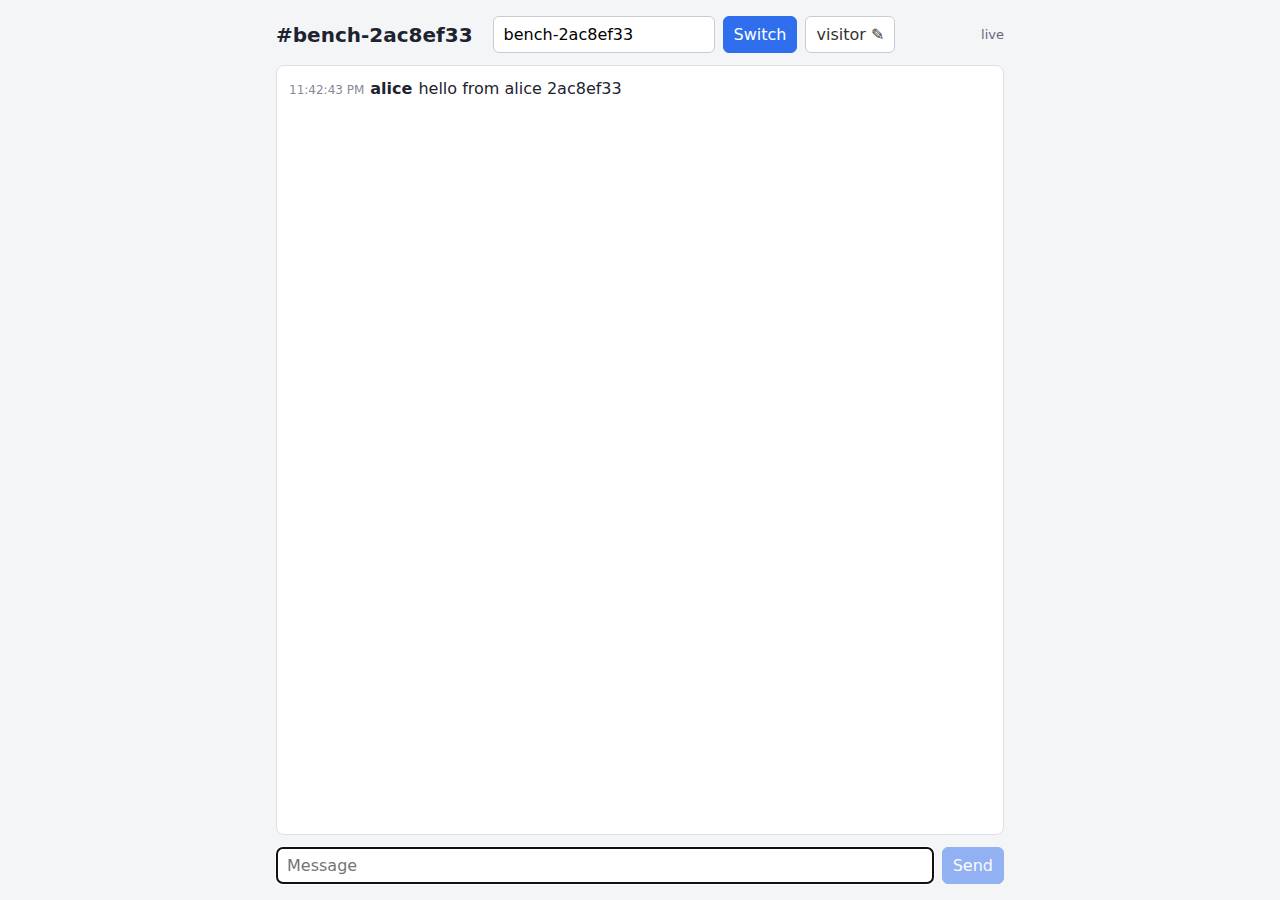
Technologies
- Runtime
- Node.js
- Frameworks
- Next.jsReact
- Libraries
- Upstash Redis SDKnode-redisVercel Functions helpers
- Dev tools
- TypeScript
- Packaging
- vercel.json
- Hosting
- Vercel project (Next.js)Vercel Functions
Named from the app's dependencies, Dockerfile and config files, and the cloud resources it created.
Checks
Black-box checks against the live URL. A cell succeeds when every required check passes. The app's spec
| Result | Check | Details |
|---|---|---|
| passed | GET / answers 2xx within 1 min ready |
|
| passed | The app is served over HTTPS with a valid certificate https |
|
| passed | The app is public: no redirect to another host such as a login page public_access |
|
| passed | GET / serves the chat UI as HTML ui |
|
| passed | deployment.json declares a supported transport (websocket or sse) transport optional |
|
| passed | Clients connect over sse connect |
|
| passed | A message reaches another client in the same room within 5 s delivery |
|
| passed | The sender receives its own message too echo optional |
|
| passed | Messages never reach clients in other rooms room_isolation |
|
| passed | Five users posting at the same time all see every message within 10 s fanout |
|
| passed | GET /api/rooms/<room>/messages returns recent messages history |
|
| passed | Messages over 1000 characters are rejected validation optional |
|
| passed | The chat UI loads in a browser without errors browser_ui optional |
Human steps
- Sign up for an account and verify the email address · 3 min
prerequisite: account setup - Create an API token and hand it to the agent · 2 min
prerequisite: account setup
Security & compliance review
An independent Claude Code session reviewed the source, the agent's sessions and the live deployment against a fixed rubric (claude-opus-5-5, high effort).
The Vercel Hobby deployment of this personal club chat app is clean. No secrets are involved or leaked, HTTPS is enforced with HSTS, no source or config files are exposed, and input validation and output escaping are sound. The main weakness is that the public POST and long-lived SSE endpoints have no rate limiting or connection caps. Minor issues: deployment protection is turned off for previews too, the CLI and dependency ranges are unpinned, and the app sets no security headers.
| Criterion | Weight | Score | Why |
|---|---|---|---|
| Secrets handling | 25 | 9/10 | The app needs no secrets and none are in the source, the build context or the deployed files. The agent confirmed via the deployment file listing that .env.local wasn't uploaded. Optional Redis credentials would be read from platform env vars. One minor issue: the Vercel token was passed as a --token command-line argument (expanded from an env var). |
| Deployment provenance | 20 | 8/10 | Production was built by Vercel from the agent's local source tree, with package-lock.json uploaded, so dependency versions are locked. But package.json uses caret ranges and @latest installs, the Vercel CLI was run as unpinned `npx -y vercel@latest`, and there is no owner-controlled remote git repo tied to the deployment. |
| Terms compliance | 15 | 9/10 | This is a personal (hobby club) app on Vercel Hobby, which Vercel's terms allow for personal, non-commercial use. As far as I know, Hobby doesn't expire or sleep functions. The message store is Runtime Cache, which is ephemeral, so history can be evicted. That is a durability limit, not a terms violation. |
| Least privilege | 15 | 8/10 | There is no public data store, and the Runtime Cache can only be reached from the project's functions. The agent turned deployment protection off completely (ssoProtection=null) rather than using Standard protection, which keeps the production alias public but leaves preview and per-deployment URLs protected. |
| Transport security | 10 | 8/10 | HTTP redirects to HTTPS with a 308, the certificate is valid and the platform adds HSTS with preload. The app sets no CSP, X-Content-Type-Options or frame protection, though it could have done so in next.config headers. |
| Attack surface | 10 | 9/10 | Requests for .env, .git, package.json, source files and .vercel all return 404, and errors return generic JSON with no stack traces. Responses still send the `x-powered-by: Next.js` header. |
| Application security | 5 | 6/10 | Input validation is solid: invalid JSON, null bodies, non-string, empty and over-1000-character text, and room names over 64 characters all get 400. React escapes user content, so there is no XSS. But the public POST and SSE endpoints have no rate limiting or connection caps, and each SSE connection holds a function for up to 270s while polling the cache every 500ms, so anyone can exhaust the Hobby quota or flood rooms. |
Findings
-
medium app No rate limiting or connection caps on public message and SSE endpoints
Evidence: app/app/api/rooms/[room]/[action]/route.ts: postMessage has no throttling; events() loops for STREAM_MS=270000 polling store.latest every POLL_MS=500 with maxDuration=300; unlimited rooms can be created. A POST to /api/rooms/sec-review-19779/messages succeeded anonymously with 201.
Fix: Add per-IP rate limiting (for example the Vercel Firewall rate-limit rules or a KV-backed limiter), cap concurrent SSE streams per IP, and cap the number of rooms or messages per period.
-
low deployment Deployment protection disabled for all deployments, including previews
Evidence: process/deploy.md:278: PATCH /v9/projects/adb-raatw-realtime-web with {"ssoProtection":null}
Fix: Use Standard Protection, which keeps the production domain public but protects preview and per-deployment URLs, rather than turning protection off entirely.
-
low deployment Unpinned deploy tooling and dependency ranges, no source repo of record
Evidence: process/deploy.md:20,222: `npx -y vercel@latest`; process/build.md:21: `npm i next@latest react@latest ...`; app/package.json uses ^ ranges. Deployed by `vercel deploy --prod` from a local directory with a local-only git repo. The lockfile was uploaded (deploy.md:707).
Fix: Pin the Vercel CLI version, keep the committed lockfile with exact versions, and deploy from an owner-controlled git repository connected to the Vercel project.
-
low app Missing CSP, X-Content-Type-Options and frame protection headers
Evidence: curl -sI https://adb-raatw-realtime-web.vercel.app/ returns only strict-transport-security (platform), with no content-security-policy, x-content-type-options or x-frame-options
Fix: Add a headers() block in next.config, or a headers entry in vercel.json, setting CSP with frame-ancestors 'none', X-Content-Type-Options: nosniff and Referrer-Policy.
-
low deployment Vercel token passed on the command line
Evidence: process/deploy.md:20 and later: VC="npx -y vercel@latest --token $VERCEL_TOKEN ..." (the transcript shows only the variable name, so nothing leaked)
Fix: Let the CLI read VERCEL_TOKEN from the environment instead of passing --token, so the token never shows up in process arguments.
-
info app Framework disclosed via x-powered-by header
Evidence: curl -sI https://adb-raatw-realtime-web.vercel.app/ returns `x-powered-by: Next.js`
Fix: Set poweredByHeader: false in next.config.
-
info deployment Message history kept in ephemeral, shared Runtime Cache
Evidence: process/deployment.json notes: Upstash couldn't be provisioned; history is in Vercel Runtime Cache (LRU eviction possible, 7-day TTL, shared on Hobby); app/lib/store.ts RuntimeCacheStore
Fix: Finish the documented human step to attach Upstash Redis (or another durable store) so room history survives eviction.
-
info app User content is rendered safely
Evidence: A POST with text "<img src=x onerror=alert(1)>" is stored verbatim and rendered as React text. GET /?room=<script>alert(1)</script> renders it escaped as <script>. The validation probes (bad JSON, null body, text 123, an empty string, 1001 characters, a 70-character room name) all returned 400.
Fix: No action needed.
Cloud resources and cost
| Traffic | Per month | How it was priced |
|---|---|---|
| Light use Barely used: a few visits a week, about 2,000 requests a month. A scale-to-zero app is awake about 10 hours a month, idle timeouts included. | $0.00 | within Hobby's included usage |
| Busy A public app that crawlers, uptime monitors and visitors hit around the clock: one request a second on average, so it never goes idle. | $20.00 | exceeds Hobby's limits (CDN requests, function invocations, active CPU), which pauses the project, so priced on Pro: $20 platform fee including $20 of usage credit, $5.75 of usage |
Resources the agent created
| Kind | Name | Plan | List price / month | Pricing |
|---|---|---|---|---|
| project | adb-raatw-realtime-web | $0.00 | no fixed fee; usage within the plan's included allowance |
The agent estimated $0.00 a month.
Code
- Code
- 540 lines in 15 files (TypeScript 431, JSON 94, JavaScript 92, Markdown 17, CSS 17)
- Dependencies
- 9 npm, 0 Python
- Deploy config
vercel.json
The agent's sessions
| Phase | Status | Time | Turns | Tokens | Cost | Shell commands |
|---|---|---|---|---|---|---|
| Build | completed | 5m 02s | 15 | 582.9K | $0.55 | 13 |
| Deploy | completed | 9m 27s | 29 | 1.99M | $1.03 | 27 |
The agent's deploy summary
The app is live at https://adb-raatw-realtime-web.vercel.app and every requirement works through that URL. Message history is held in a cache that can lose old messages, because the durable Redis store needs a person to accept terms first (see below).
What's deployed
- Project:
adb-raatw-realtime-web, Next.js on the Hobby plan (free), running in Vercel'siad1region. I turned off Vercel Authentication, which had been blocking public access to the.vercel.appURL. - Real-time: Server-Sent Events, because Vercel functions can't hold WebSocket connections.
deployment.jsonhas"realtime": {"transport": "sse"}, and there is no/wsendpoint. - Storage: Vercel Runtime Cache, which is free on Hobby and shared by all instances of the app's functions. It has no atomic operations, so each instance writes only its own message log, and a per-room list of writers is updated with read-and-retry so simultaneous posts aren't lost.
Tested through the public URL
- Test suite: all 4 tests pass, covering the page, message format, 50-message history in order, the
400cases, and room isolation. 20 simultaneous posts reached 2 listeners in under 2s. - Stress test: run 3 times, 45 posts from parallel senders. All 4 listeners got every message each time, at most about 1.1s after sending, and history had all 45.
- Browser test: in headless Chromium, a second user saw messages live, a user in another room didn't, and a new joiner saw history.
What didn't work
- Durable Redis: setting up Upstash needs its marketplace terms accepted in a browser by a person. This is listed under
human_stepsas non-blocking. - Data loss risk: until that's done, history isn't durable. Cached messages can be evicted at any time and expire after 7 days. On Hobby the cache is also shared with the team's other projects.
- One flaky run: the first full test run after this change had one history test fail. I didn't capture which check failed, and the cause is unconfirmed; a race during cold start is the likely one. Every run since has passed.
To switch to Redis, a person accepts the terms at https://vercel.com/ai-deploy-bench/~/integrations/accept-terms/upstash?source=cli. Then run vercel integration add upstash/upstash-kv --name adb-raatw-realtime-redis and vercel deploy --prod. The app picks up the Redis settings automatically.
Changes in this step
- All room endpoints now live in one route file.
- The browser subscribes to the stream before loading history, so no message falls in the gap.
- Message IDs are now strings.
vercel.jsonsets the framework to Next.js.
Estimated cost is $0/month. I didn't create any credentials, so .env wasn't needed. No servers are left running, and the work is committed locally.
27 shell commands during deploy
- 5s
cd /home/runner/work/_temp/adb-raatw-realtime; npx -y vercel@latest --version 2>&1 | tail -1; curl -s -H "Authorization: Bearer $VERCEL_TOKEN" "https://api.vercel.com/v1/storage/stores?teamId=$VERCEL_ - 30s
cd /home/runner/work/_temp/adb-raatw-realtime; export VC="npx -y vercel@latest --token $VERCEL_TOKEN --scope $VERCEL_TEAM_ID"; $VC project add adb-raatw-realtime-web 2>&1 | tail -2; $VC link --yes --p - 36s
cd /home/runner/work/_temp/adb-raatw-realtime; VC="npx -y vercel@latest --token $VERCEL_TOKEN --scope $VERCEL_TEAM_ID"; $VC integration --help 2>&1 | head -40 - 39s
cd /home/runner/work/_temp/adb-raatw-realtime; VC="npx -y vercel@latest --token $VERCEL_TOKEN --scope $VERCEL_TEAM_ID"; $VC integration add --help 2>&1 | sed -n 1,60p - 42s
cd /home/runner/work/_temp/adb-raatw-realtime; VC="npx -y vercel@latest --token $VERCEL_TOKEN --scope $VERCEL_TEAM_ID"; $VC integration add upstash/upstash-kv --name adb-raatw-realtime-redis --non-int - 1m 11s
cd /home/runner/work/_temp/adb-raatw-realtime/app/api/rooms/\[room\] && mkdir -p '[action]' && python3 - <<'EOF' - 1m 15s
cd /home/runner/work/_temp/adb-raatw-realtime && f='app/api/rooms/[room]/[action]/route.ts' && cat -s "$f" > /tmp/r && mv /tmp/r "$f" && npm run build 2>&1 | grep -E 'ƒ|rror' ; (npx next start -p 3123 - 1m 27s
cd /home/runner/work/_temp/adb-raatw-realtime; VC="npx -y vercel@latest --token $VERCEL_TOKEN --scope $VERCEL_TEAM_ID"; $VC deploy --prod --yes 2>&1 | grep -vi plugin | tail -8 - 1m 54s
cd /home/runner/work/_temp/adb-raatw-realtime; echo '{ "framework": "nextjs" }' > vercel.json; VC="npx -y vercel@latest --token $VERCEL_TOKEN --scope $VERCEL_TEAM_ID"; $VC deploy --prod --yes 2>&1 | g - 2m 26s
cd /home/runner/work/_temp/adb-raatw-realtime; curl -s -H "Authorization: Bearer $VERCEL_TOKEN" "https://api.vercel.com/v9/projects/adb-raatw-realtime-web?teamId=$VERCEL_TEAM_ID" | python3 -c "import - 2m 32s
cd /home/runner/work/_temp/adb-raatw-realtime; curl -s -XPATCH -H "Authorization: Bearer $VERCEL_TOKEN" -H 'Content-Type: application/json' "https://api.vercel.com/v9/projects/adb-raatw-realtime-web?t - 4m 35s
cat /tmp/claude-1001/-home-runner-work--temp-adb-raatw-realtime/880f54ab-6b61-41de-8e0c-ca9f803bf7c3/tasks/b2ynld44g.output - 4m 49s
cd /home/runner/work/_temp/adb-raatw-realtime; pkill -f "node --test" ; curl -s -H "Authorization: Bearer $VERCEL_TOKEN" "https://api.vercel.com/v9/projects/adb-raatw-realtime-web?teamId=$VERCEL_TEAM_ - 4m 53s
curl -s -H "Authorization: Bearer $VERCEL_TOKEN" "https://api.vercel.com/v9/projects/adb-raatw-realtime-web?teamId=$VERCEL_TEAM_ID" | python3 -c "import json,sys;d=json.load(sys.stdin);print(d.get('re - 5m 41s
cd /home/runner/work/_temp/adb-raatw-realtime; npm i @vercel/functions 2>&1 | tail -1; grep -n "getCache\|interface\|export" node_modules/@vercel/functions/cache/*.d.ts 2>/dev/null | head -30 || ls no - 5m 42s
cd /home/runner/work/_temp/adb-raatw-realtime; sed -n 1,80p 'app/api/rooms/[room]/[action]/route.ts' | sed -n 45,110p - 5m 46s
cd /home/runner/work/_temp/adb-raatw-realtime; cat node_modules/@vercel/functions/cache/types.d.ts | sed -n 1,60p - 6m 08s
cd /home/runner/work/_temp/adb-raatw-realtime; python3 - <<'EOF' - 6m 18s
cd /home/runner/work/_temp/adb-raatw-realtime; (VERCEL=1 npx next start -p 3126 > /tmp/s3.log 2>&1 &); (npx next start -p 3127 > /tmp/s4.log 2>&1 &); sleep 4; for p in 3126 3127; do BASE_URL=http://lo - 6m 32s
cd /home/runner/work/_temp/adb-raatw-realtime; python3 - <<'EOF' - 7m 03s
cd /home/runner/work/_temp/adb-raatw-realtime; U=https://adb-raatw-realtime-web.vercel.app; BASE_URL=$U timeout 100 node --test --test-name-pattern="history" tests/api.test.mjs 2>&1 | grep -A12 Assert - 7m 16s
cd /home/runner/work/_temp/adb-raatw-realtime; U=https://adb-raatw-realtime-web.vercel.app; for i in 1 2; do BASE_URL=$U timeout 100 npm test 2>&1 | grep -E '^(✔|✖)|actual|expected|got|^\s+[+-] ' | he - 7m 42s
mkdir -p /tmp/stress && cat > /tmp/stress/s.mjs <<'EOF' - 7m 57s
cd /home/runner/work/_temp/adb-raatw-realtime; for i in 1 2; do node /tmp/stress/s.mjs https://adb-raatw-realtime-web.vercel.app; done; BASE_URL=https://adb-raatw-realtime-web.vercel.app timeout 100 n - 8m 31s
mkdir -p /tmp/pw && cd /tmp/pw && npm init -y >/dev/null && npm i playwright@latest >/dev/null 2>&1 && npx playwright install --with-deps chromium >/dev/null 2>&1; cat > ui.mjs <<'EOF' - 9m 00s
cd /home/runner/work/_temp/adb-raatw-realtime; D=$(curl -s -H "Authorization: Bearer $VERCEL_TOKEN" "https://api.vercel.com/v6/deployments?teamId=$VERCEL_TEAM_ID&projectId=adb-raatw-realtime-web&limit - 9m 16s
cd /home/runner/work/_temp/adb-raatw-realtime; python3 - <<'EOF'
Raw data
Report on GitHub Full record (JSON) Workflow run, with transcripts